12VHPWR (12-pin + 4 sense wires) is the new power connector designed for next-generation graphics cards that use PCIe Gen 5, including:
– NVIDIA RTX 4000 series
– NVIDIA RTX 5000 series
– Selected AMD RX 9070 series models
Compared to the older and widely used Mini-Fit PCIe power connectors, the 12VHPWR connector uses different materials and a new internal design to support much higher power delivery. Because of this, 12VHPWR cables require stricter material standards, including:
– High-current crimp terminals
– Thicker conductors (16 AWG / 1.2 mm²)
Our 12VHPWR cables are built with individually crimped wires, not soldered joints like those found in many stock adapters.
We use a semi-automated crimping machine to ensure:
– Consistent crimp quality
– Proper contact pressure
– Reliable long-term performance
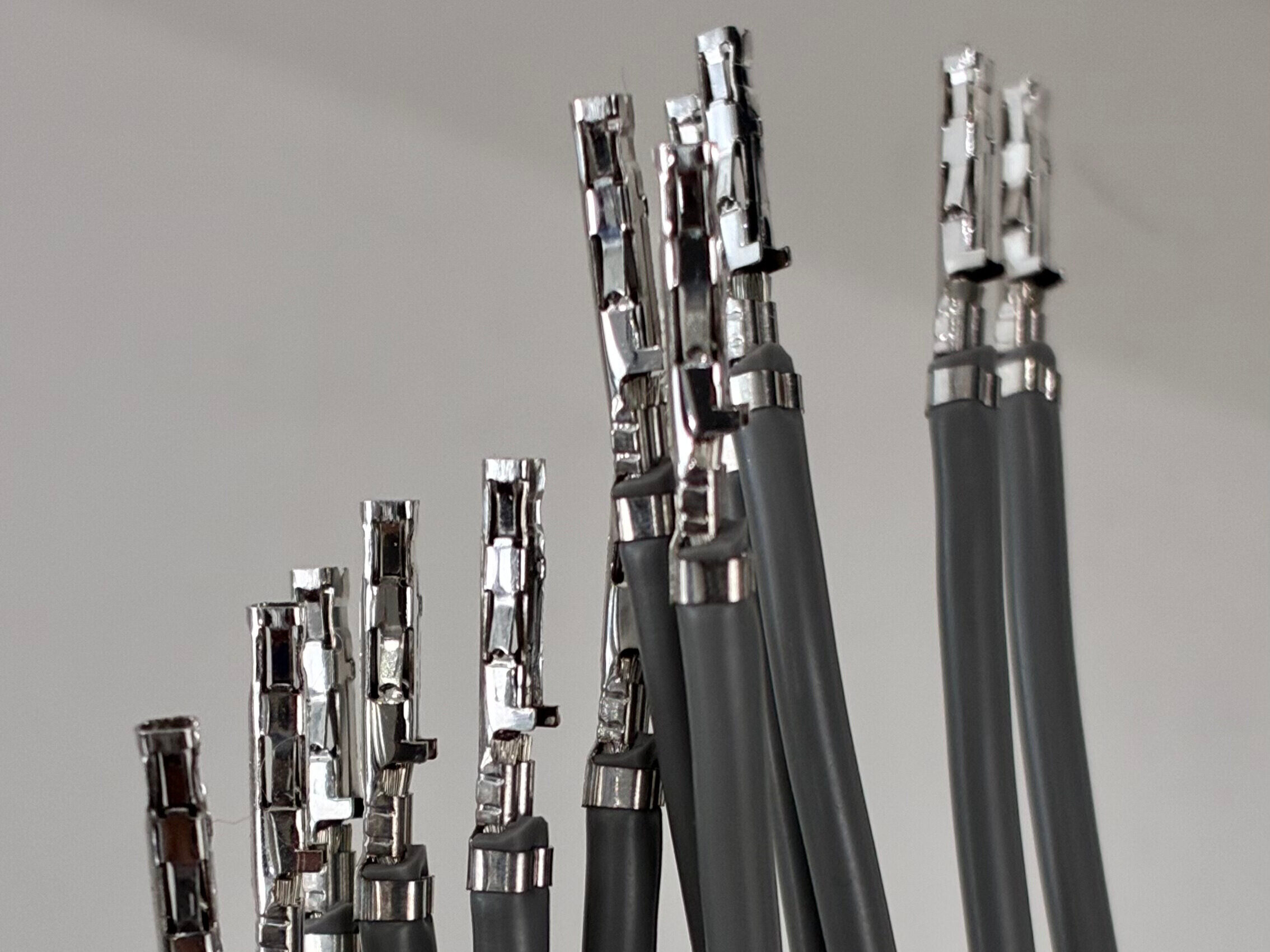
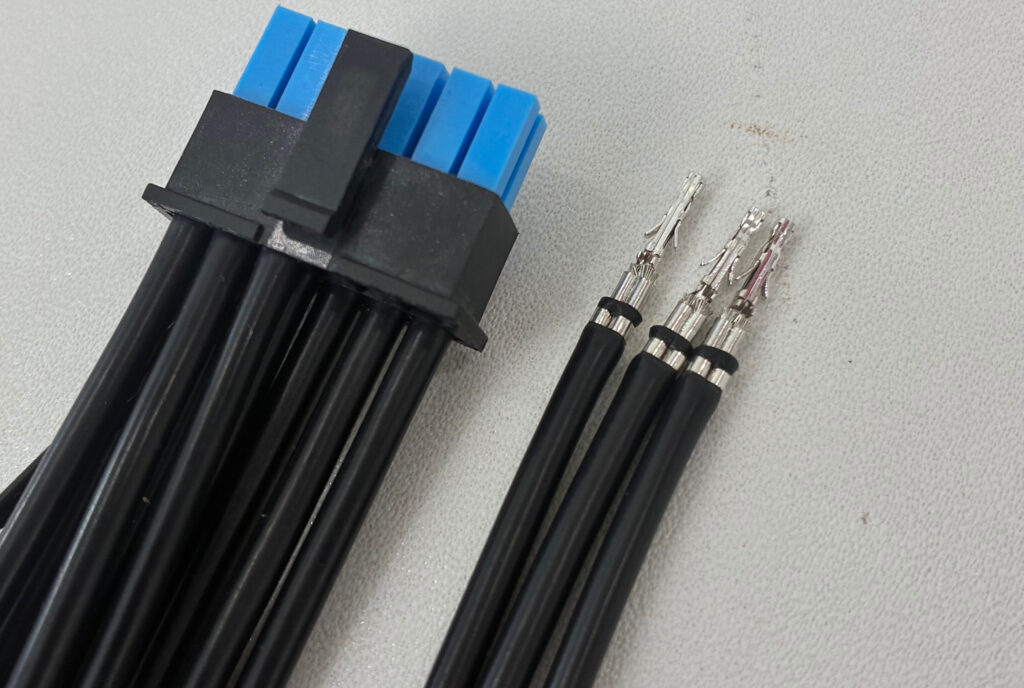
This approach significantly reduces resistance and heat buildup compared to soldered adapters.
The 12VHPWR connector includes four sense wires, which communicate power capability to the GPU.
| Sense 0 | Sense 1 | Initial Permitted Power at System Power Up | Maximum Sustain Power After Software Configuration |
| Gnd | Gnd | 375 W | 600 W |
| Open | Gnd | 225 W | 450 W |
| Gnd | Open | 150 W | 300 W |
| Open | Open | 100 W | 150 W |
Source: Intel ATX 3.0 Design Guide (Rev 2.1a, November 2023)
Required sense wires
– S3 (Sense0)
– S4 (Sense1)
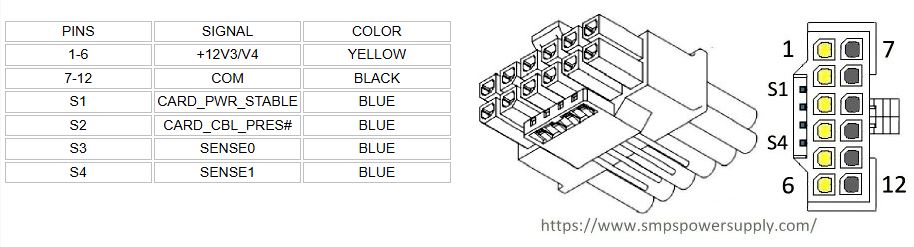
These two wires enable full 600 W power delivery.
They must be connected to ground pins and can technically be terminated on either end (GPU or PSU).
Our design choice:
We terminate these sense wires on the GPU side, which:
– Prevents accidental pulling or breakage
– Avoids boot failure or black screen issues caused by broken sense wires
Unused sense wires
– S1 and S2 are not required
– We intentionally leave them unconnected
This follows the official specification and avoids unnecessary complexity.
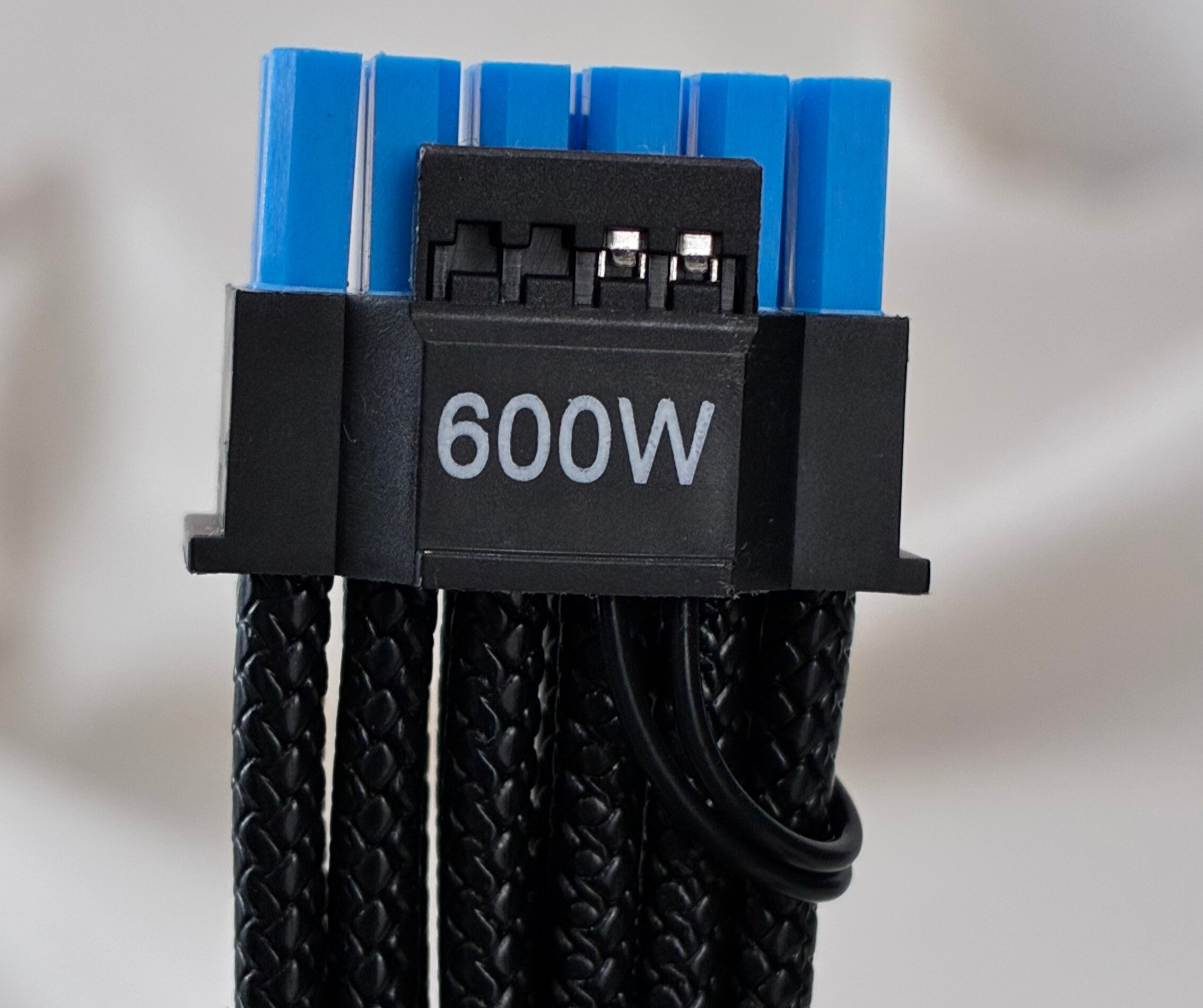
12V-2×6 is an updated standard, but the update applies mainly to the GPU and PSU sockets (headers) — not the cable itself. That means:
– The cable and terminals remain the same
– Existing 12VHPWR cables and adapters are fully compatible
– A 12VHPWR cable will work correctly with a 12V-2×6 connector
For practical use, 12VHPWR and 12V-2×6 cables are the same thing.
Our 12VHPWR / 12V-2×6 cable is rated for up to 600 W.
Power calculation:
6 × 12 V wires × 12 V × 9.2 A = 662.4 W
This provides sufficient margin for a 600 W load.
For non-native cables, an example:
12VHPWR / 12V-2×6 → 2× 8-pin PCIe):
– The power rating is equivalent to a 3× or even 4× 8-pin PCIe configuration
– The cable is theoretically capable of delivering up to 600 W
Why only 2× 8-pin on the PSU side?
Using 2× 8-pin is done to simplify termination, not to limit power.
On a single-rail PSU:
– 2× 8-pin and 3× 8-pin have the same current capability
– There is no practical difference in maximum power delivery
The difference is only in how the 12 V and ground wires are distributed:
2× 8-pin
– Each connector: 3× 12 V + 3× Ground
3× 8-pin
– Each connector: 2× 12 V + 2× Ground
Regardless of PSU-side configuration, a 12VHPWR / 12V-2×6 cable always contains:
– 6× 12 V wires
– 6× Ground wires
– 2× Sideband (sense) wires
The power rating of a 12VHPWR cable is not determined by the number of connectors, but by:
– Wire gauge
– Terminal current rating
– Sense-wire (sideband) configuration
Yes — our 12VHPWR / 12V-2×6 cables are covered under our standard warranty for manufacturing defects, including incorrect pinout or assembly errors.
However, as widely documented within the industry, 12VHPWR and 12V-2×6 connector standards may be susceptible to overheating or melting under certain conditions due to design sensitivities.
While Cablester Custom manufactures these cables in strict compliance with official specifications and applies quality control procedures to ensure proper assembly and pin accuracy, certain external variables cannot be fully controlled. These include, but are not limited to:
– GPU-side connector tolerances
– Insertion depth and seating
– System load characteristics and transient spikes
– User installation practices
For this reason, warranty coverage does not extend to damage resulting from overheating, melting, or connector interface failure related to 12VHPWR or 12V-2×6 usage.
We strongly recommend ensuring proper insertion, avoiding excessive load conditions, and following manufacturer guidelines when using these connector types.
Learn more: How Nvidia made the 12VHPWR connector even worse
There is a known design limitation with the 12VHPWR standard — even with the updated 12V-2×6 version.
The issue is the low safety factor, meaning the connector operates closer to its maximum limits than older PCIe power connectors.
Safety factor comparison:
– 600 W power limit → Safety factor ≈ 1.10
– 450 W power limit → Safety factor ≈ 1.47
(similar to the older 8-pin PCIe standard)
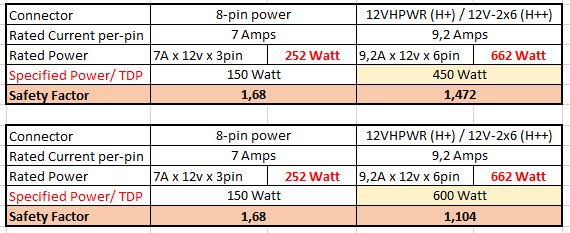
This limitation is inherent to the connector design defined by NVIDIA and is outside the control of cable manufacturers.
Use our PCIE calculator here: PCIE Cables Safety Calculator
To ensure compliance and reliability, we strictly follow the specification:
– Wire: 16 AWG (1.2 mm²)
– Terminals: 4-spring, high-current Micro-Fit system (9.2 A)
– Housing: H++ material, UL94-V0 flame-retardant rated
All materials are selected to operate well within their rated limits.
See Technical Information for detailed specifications.
Due to the inherent design limitations of the 12VHPWR / 12V-2×6 standard, we strongly recommend:
– Limiting GPU power
– Or undervolting your GPU
This is especially advised for RTX 4090 and RTX 5090, as it:
– Increases the safety margin
– Reduces connector stress
– Lowers operating temperature
– Improves long-term reliability